One each, plus spares
The first mistake is arithmetic. Thirty children, one of something each, so you buy thirty. Then one drops it, one tears it, one loses it before the period ends, and the second teacher in the same week needs the same thing for her own thirty. Thirty is the smallest number that is guaranteed to be wrong.
The right margin depends on what the thing is. A consumable that gets used up, like cardstock or cupcake liners, should carry a margin of about twenty percent on top of the headcount. Thirty children, so buy for thirty-six. A tool that gets shared, like a punch or a die, needs a smaller margin, but it needs a different kind of spare: a second copy of the most-used size, because the first one will be the one that gets dropped.
There is a second arithmetic that teachers often miss. A class of thirty is rarely just thirty. There is the child who joins in October, the child who comes back after an absence and needs the catch-up sheet, the child who finishes early and wants to do the same activity again. The thirty-first and thirty-second child are not hypothetical. They are the reason the cupboard has a spares shelf.
| What a class of thirty consumes in a term | Count | What you actually need |
|---|---|---|
| Cardstock sheets, one per child per activity | 30 per activity | 36 per activity |
| Cupcake liners, one per child | 30 | 36 |
| Notebooks, one per child per term | 30 | 35 |
| Binding spines, one per child per project | 30 | 36 |
| Stickers or small rewards | 30 per week | 40 per week |
The pattern holds across every consumable. Buy for the class, then add the margin. The margin is not waste. It is the difference between a lesson that runs and a lesson that stops while someone runs to the office.
Consumables against tools
The cupboard holds two different kinds of things, and they behave differently. Consumables are used up. Cardstock, liners, stickers, notebooks, binding spines: once they are cut, folded, stuck, or written in, they are gone. Tools are kept. Punches, dies, spinners, binding tools: they sit in the cupboard and come out again.
Because they behave differently, they are bought on different rhythms. Consumables are bought by the term, sometimes by the month, and the budget follows the calendar. Tools are bought once, and the budget follows the need. A punch that does the job well will do it for years. A pack of cardstock is gone by December.
The mistake is to treat both the same way. If you buy tools as if they were consumables, you end up with six cheap punches that all do the same job and none of them well. If you buy consumables as if they were tools, you end up with a cupboard of cardstock that has gone soft and curled at the edges.
The practical rule is to keep two lists. One list is the consumables, with a termly count and a date attached. The other list is the tools, with no date at all. Tools get replaced when they break, not when the calendar turns.
What the punch sizes are for
Circle punches come in sizes for a reason. The 2 inch punch makes a circle big enough to be a face, a sun, a badge, or a base for a larger shape. The 1 inch punch makes a circle for eyes, buttons, wheels, or a label. The 0.6 inch punch makes a dot, and dots are the workhorse of classroom craft: twenty of them on a card becomes a pattern, a border, or a set of counters.
The CHENGU circle hole punch set of three, at $19.99, covers all three sizes in one box. That is the set to buy when you want one of each and you do not want to think about it again.
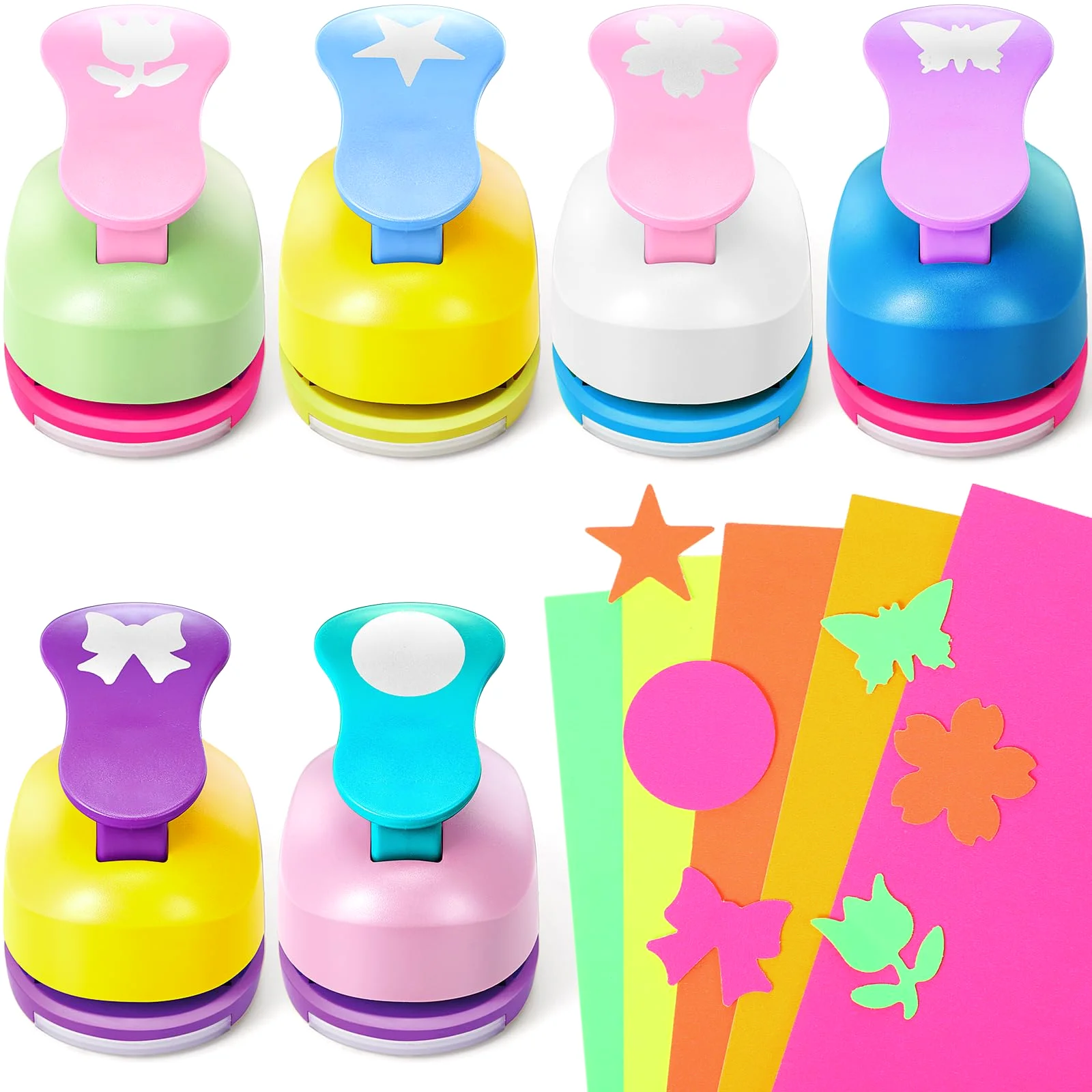
The six-shape hole punch set with cardstock, at $25.99, adds shapes the circle cannot do: a star, a heart, a square, a triangle, and the others in the set. The cardstock that comes with it is worth holding onto. It is the right weight for the punches, which is a detail that matters more than people think.
| Punch or die | Size or set | What it does |
|---|---|---|
| Circle punch, 2 inch | 2 in | Faces, suns, badges, bases |
| Circle punch, 1 inch | 1 in | Eyes, buttons, wheels, labels |
| Circle punch, 0.6 inch | 0.6 in | Dots, patterns, borders, counters |
| Six-shape set with cardstock | six shapes | Stars, hearts, squares, triangles |
| Christmas word cutting dies | 21 dies | Words and shapes for holiday cards |
A punch used on card that is too thick will fight you. It will jam, it will tear the paper instead of cutting it, and eventually it will dull the cutting edge. The rule is simple: use the cardstock the pack recommends, and if the punch starts to resist, the card is too thick, not the punch too weak. Stop, change the card, and the punch will last.
Word and shape cutting dies are the next step up. The 21 Christmas word cutting dies at $8.99 give a classroom a set of holiday words and shapes that can be cut once and traced many times. Dies are tools, not consumables. They are bought once and they outlast the cardstock they cut.
Binding and keeping work together
A project that falls apart in a school bag is not a project, it is a memory of one. Binding is the difference between work that survives the journey home and work that arrives as a scatter of loose pages.
Twin loop binding spines at 9/16 inch, 24 of them for $14.99, are the size for a modest stack of pages: a report, a story, a set of worksheets. They are easy to open, easy to close, and easy for small hands to manage. The 9/16 inch spine holds a comfortable number of sheets without bulging.
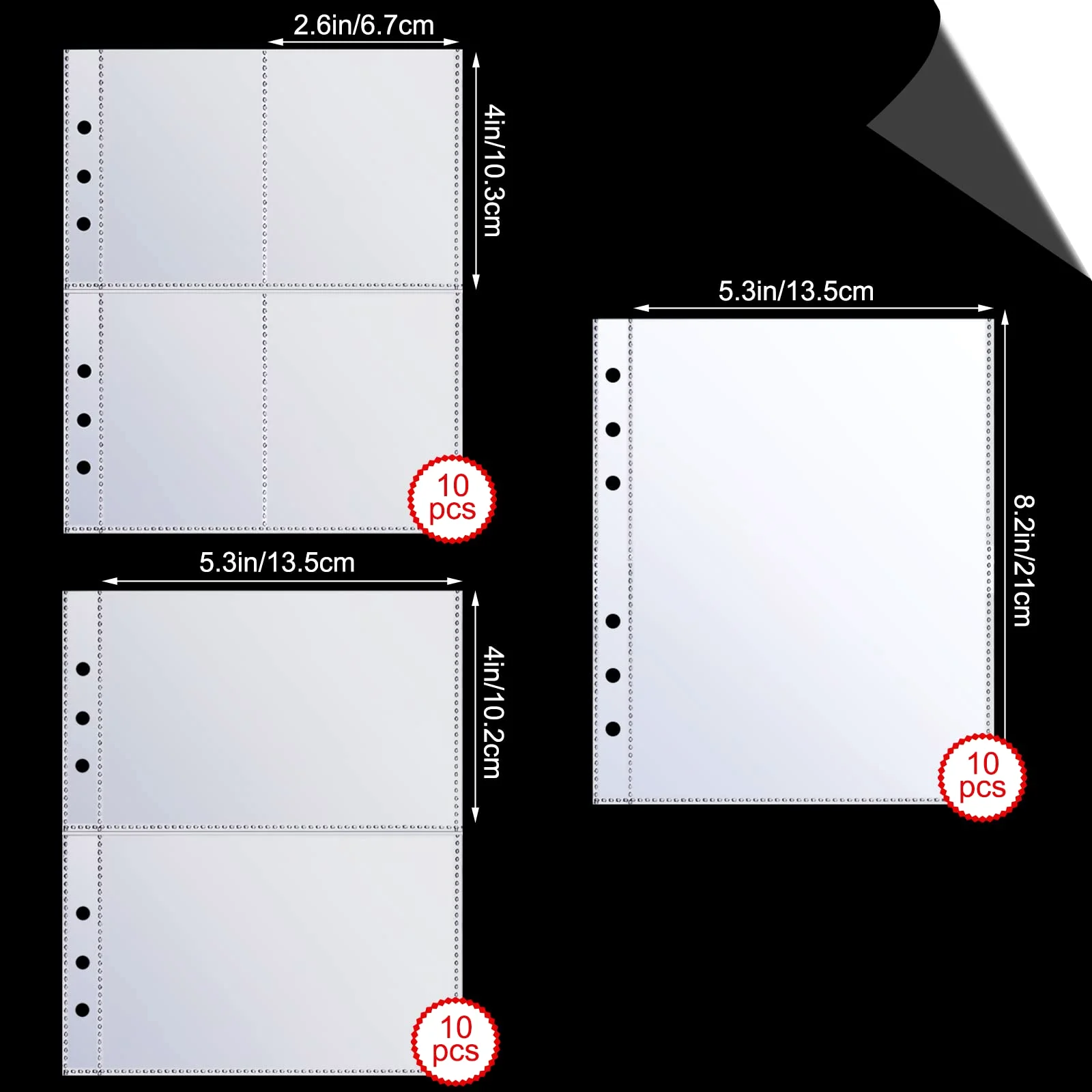
Clear A5 binder pockets, 30 for $6.59, are the other half of the system. A finished piece goes in a pocket, the pocket goes in a binder, and the binder goes in the bag. The clear front means the work is visible without opening anything. For a teacher collecting a term's worth of work, the pockets are the difference between a tidy portfolio and a pile of paper that has to be sorted at the end of term.
The notebooks in fifties, the gilded prayer journal notebooks at $18.99 for 50, are the consumable side of the same system. One per child per term, plus the margin. The gilded covers make them feel like something worth keeping, which matters for the children who are not used to their work being treated as valuable.
What survives a school bag is a function of how it is put together. Loose sheets do not survive. Sheets bound with a spine survive. Sheets in a clear pocket survive better. A child who knows their work will survive the walk home is a child who will take more care making it.
Safety and labeling, read once
The regulations that govern art materials are not complicated, but they are specific. Under the Labeling of Hazardous Art Materials Act, art materials must be assessed for chronic hazard at least every five years and must carry a statement that reads "Conforms to ASTM D-4236". If a pack does not carry that statement, do not hand it to a child.
Paint with more than 0.009 percent lead, which is 90 parts per million, is banned under 16 CFR part 1303. That is a hard number and it is not open to interpretation. The paint either meets it or it does not, and the pack should say so.
Separately, the CPSC small parts ban at 16 CFR part 1501 covers children's products intended for children under three. Whether something is a small part is decided by a simple test: does it fit entirely, uncompressed and in any orientation, into the small parts cylinder? The cylinder approximates the throat of a child under three. If it fits, it is a small part, and it cannot be in a product for a child under three.
Choking hazard warning labels are required at 16 CFR 1500.19. Those labels are not decoration. They are the difference between a product that is legal and a product that is not.
Read the pack once before the lesson, not after the first cut. The wording on the pack governs.
That is the practical rule. The wording printed on the pack is the final authority. If a pack says a thing is for ages three and up, it is for ages three and up. If it says a thing is a choking hazard, it is a choking hazard. A teacher opening thirty of something should read the pack once before the lesson, not after the first cut. The ten seconds it takes to read the label can save a lesson, or worse, a child.
Storage that survives a term
A cupboard runs out for one of two reasons. Either the school did not buy enough, or the school cannot find what it bought. The second reason is more common, and it is the one you can fix without spending money.
The rule is three words: labelled, counted, put back. A cupboard where every box has a label on the front, where the count is written on the label, and where things go back to the same place every time, does not run out. It runs low, and running low is a different thing. Running low is a signal to buy. Running out is a failure of storage.
The practical version of this rule is simple. When a new pack arrives, write the count on the box in marker. When a box is opened, write the remaining count on the outside. When something is borrowed, the borrower writes their name on a sheet taped to the cupboard door. None of this takes more than a minute, and all of it prevents the most expensive mistake in classroom craft: buying a second box of something that is already in the cupboard, hidden behind a third box of something else.
The labelled shelf should be a habit, not a project. It is the difference between a cupboard that serves the classroom and a cupboard that is a black hole with a door on it.
Running an activity for thirty
The night before is where the lesson is won. Preparation is not the same as planning. Planning is deciding what the children will do. Preparation is making sure the materials are ready for thirty children to do it.
For a craft activity, preparation means pre-cutting. Anything that can be cut before the lesson should be cut before the lesson. The children are there to make something, not to wait while an adult cuts thirty identical circles. Pre-cut the circles, pre-fold the card, pre-count the liners. The lesson itself should be about the making, not the logistics.
Count the spares before you count the children. The spares are the lesson.
How many spinners, punches, or dies does a room of thirty need? The answer is fewer than you think, if they are shared between tables. A table of six children can share one punch or one set of dies, because they take turns. A class of thirty, at six per table, needs five punches or five sets of dies, not thirty. The CHENGU 25 classroom game spinners at $6.59 is a pack of 25, which covers a class of thirty with five spares, and at that price the spares are not a luxury.
The same logic applies to punches. The three-piece circle punch set is one punch per table, and the six-shape set is one per table. Five tables, five punches, done. The children learn to wait their turn, which is a lesson in itself, and the activity does not stop while one punch is passed around thirty children.
The night before, lay out the tables. Each table gets its own pile: the pre-cut pieces, the materials, the shared tool. In the morning, the children sit down and start. The teacher's job is to teach, not to distribute.
Groups that are not a class
A class of thirty is the standard case, but it is not the only case. A church group, a scout troop, a care home craft afternoon: the counts are different and the constraints are different.
A church group is often a mixed-age group. The small parts ban matters more here, because the group may include children under three. The rule is the same as in a classroom: read the pack, check the age range, and keep small parts away from the youngest. A church group also tends to have a different rhythm: a one-off event rather than a term. That changes the buying. For a one-off, the margin can be smaller, because there is no second week to plan for.
A scout troop is closer to a class, but the children are often more active and the activities are often messier. The margin should be bigger, not smaller. A scout who drops a punch on a forest floor is a scout who has lost a punch. The spares are not a luxury. They are the activity.
A care home craft afternoon is the opposite in one important way. The participants are not children, so the small parts ban does not apply, but the motor skills may be different. A punch that is easy to squeeze matters. A die that cuts cleanly on the first press matters. The buying is the same. The use is different. Buy the same tools, but plan for slower hands and more help.
The common thread is the arithmetic. Count the heads, add the margin, read the packs, and store what is left. The shape of the group changes the details, not the method.
The end of the year
At the end of the year, the cupboard is a mix of the used and the unused. The used is the evidence of a year of work. The unused is the next year's starting point, if it is handled properly.
The first thing to do is count. Count everything, write the counts down, and compare them to the start-of-year list. The difference is what was actually consumed, and that difference is the basis for next year's buying. A class that went through forty cardstock sheets per activity needs forty next year, not thirty-six.
The second thing is to decide what is worth keeping. Cardstock that has gone soft is not worth keeping. Liners that have been crushed are not worth keeping. Punches that have jammed one too many times are not worth keeping. The end of the year is the moment to throw things away, and throwing things away is not waste. It is making room for next year.
The third thing is to store what is kept. The labelled, counted, put-back system works all year, but it does its best work at the end of it. A cupboard that ends the year in order is a cupboard that starts the next year in order. A cupboard that ends the year in chaos is a cupboard that starts the next year in chaos, and chaos is expensive.
There is a fourth thing, and it is the one most people skip. Give away what you cannot use. A church group, a scout troop, a care home: they all need what a school has left over. The leftover cardstock, the half-used pack of liners, the spare notebooks: they are not waste, they are a donation. The end of the year is the moment to pass them on, and passing them on is the difference between a cupboard that is empty and a cupboard that is merely tidy.
A start-of-year list
The start-of-year list is the whole method in one page. It is the arithmetic, the tools, the consumables, the margin, and the storage, all reduced to a shopping list.
For a class of thirty, with the margin built in, the list looks like this:
- Circle hole punch set of three, $19.99, one per two tables
- Six-shape hole punches with cardstock, $25.99, one per two tables
- 25 classroom game spinners, $6.59, one pack for the year
- 50 gilded prayer journal notebooks, $18.99, one per child plus spares
- 24 twin loop binding spines, $14.99, one pack per major project
- 30 clear A5 binder pockets, $6.59, one per child for the portfolio
The counts behind the list are the counts from the tables above. Thirty children, one each, plus the margin. The tools are shared, so they are bought once. The consumables are used up, so they are bought by the term. The list is the method, and the method is the list.
| Item | Pack | Price | What it covers |
|---|---|---|---|
| Circle hole punch set | 3 punches | $19.99 | One per two tables |
| Six-shape hole punches with cardstock | 6 shapes | $25.99 | One per two tables |
| Classroom game spinners | 25 | $6.59 | One per child plus spares |
| Gilded prayer journal notebooks | 50 | $18.99 | One per child plus spares |
| Twin loop binding spines | 24 | $14.99 | One major project |
| Clear A5 binder pockets | 30 | $6.59 | One per child, portfolio |
| Christmas word cutting dies | 21 | $8.99 | One set for the season |
The final number is the one that matters. The whole list, tools and consumables together, comes to about $102. For a classroom that will use every item on the list, that is the price of a year of craft that works. The arithmetic is not complicated. It is one each, plus the spares, and the spares are the lesson.
Keep reading
- Setting a table for a hundred: how many of everything you actually need. Glasses per guest, bottles per hour, and the two-hour rule that decides how the food goes out. The arithmetic behind a room full of people.
- The multi-pack rule: which household things are worth buying by the dozen. Three questions decide it: does it get used up, does it get lost, does it store flat. Everything else should be bought one at a time.
- Or go back to the CHENGU catalog and the fifty packs on the front page.