Start with the guest count
Everything else follows from one number: how many people are coming. Not the number on the invitation, the number who actually show. For a hundred invited, plan for ninety. For a hundred confirmed, plan for a hundred and a few extra plates. The second number is how long they will be standing. A cocktail hour and a seated dinner are different problems. A three hour standing reception is different again. People drink faster standing, they eat less sitting, and they abandon glasses in both cases.
The third number is whether they sit. Seated guests use more glasses because water, wine, and a toast are three different vessels. Standing guests use fewer, but they lose track of the one in their hand and go get another. The most common mistake is buying one glass per guest. It sounds like enough. It is not. By the second hour, a third of the room has set a glass down on a windowsill, forgotten it, and picked up a fresh one. You will run out at hour two with a hundred people still holding empty hands.
A working rule: for a standing event, plan on two to three glasses per guest over the evening. For a seated dinner, three to four. That is the number that everything else in this guide hangs from.
Drinks arithmetic, done honestly
The US standard drink is about 14 grams, or 0.6 fluid ounces, of pure alcohol. That is a 12 oz beer at 5 percent, a 5 oz glass of wine at 12 percent, or a 1.5 oz shot of spirits at 40 percent. Everything below starts from that.
For a four hour evening, a reasonable planning number is 2.5 to 3 drinks per guest total. Some guests drink nothing. Some drink four. The average lands near three if the bar is open and the room is warm. If you are pouring, you are also pacing, and that is your job, not the glassware's.
Wine comes in 750 ml bottles, which is about 25 oz, or five 5 oz glasses. For a hundred guests, if a third of the drinks are wine, that is about 85 glasses, or 17 bottles. If half the drinks are wine, it is 125 glasses, or 25 bottles. Buy the higher number if the crowd skews toward wine. Beer comes in 12 oz servings. A twelve-pack is twelve drinks. For a hundred guests, if a third of the drinks are beer, that is about 85 beers, or seven twelve-packs. Round up to eight. Nobody is sad about extra beer. Spirits are the most efficient. A 750 ml bottle holds about 16 shots. For a hundred guests, if a third of the drinks are cocktails, that is about 85 shots, or six bottles. Add mixers, juice, and soda at roughly a liter per bottle of spirits.
| Drink | Standard pour | Per guest, 4 hours | For 100 guests | What to buy |
|---|---|---|---|---|
| Wine | 5 oz | 1.5 to 2 glasses | 150 to 200 glasses | 30 to 40 bottles |
| Beer | 12 oz | 1 to 1.5 | 100 to 150 beers | 9 to 13 twelve-packs |
| Spirits | 1.5 oz | 1 to 1.5 | 100 to 150 shots | 7 to 10 bottles |
| Glasses, standing | n/a | 2 to 3 | 200 to 300 | 2 packs of 150 flutes |
| Glasses, seated | n/a | 3 to 4 | 300 to 400 | 2 packs of 200 flutes |
Here is the honest part. These numbers assume you are pouring standard pours. If you free-pour, you will pour 2 oz instead of 1.5, and your bottle count goes up by a third. Use a jigger, or use a pour spout with a measured pour, and the arithmetic holds.
Pour the first round yourself. It sets the pace for the whole room.
Disposable or wash up
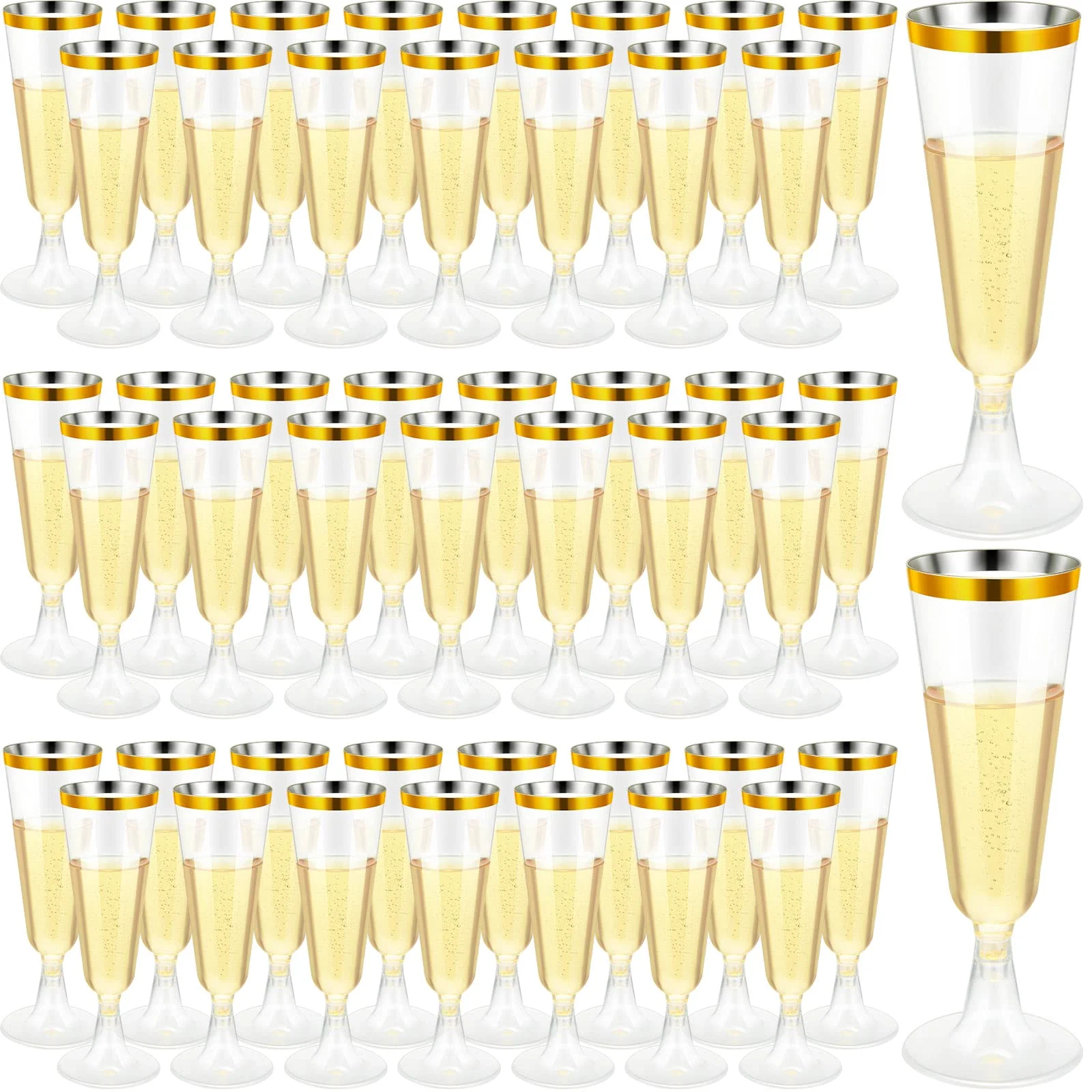
Plastic flutes are the right answer for a hundred guests standing in a yard with no dishwasher in sight. CHENGU packs 150 clear plastic champagne flutes at $43.99, and 200 gold rim 5 oz flutes at $58.99. At those prices, the disposables cost less than the labor of washing a hundred glasses twice. The gold rim flutes are 5 oz, which is exactly a standard wine pour. That matters. A 5 oz flute that is full is a standard drink. A 9 oz flute that is full is nearly two. The glassware sets the portion, so buy the size that matches the pour you want.
When disposables are the wrong answer: a seated dinner where the table is dressed and the light is low. Plastic reads as plastic. If the event is a wedding or an anniversary and the photos will outlive the evening, rent glass or borrow it. The cost is not the glass, it is the washing. What happens to the leftovers. You will have some. A pack of 150 for a hundred guests leaves fifty flutes, and those are not a loss. They are next year's picnic cups, the kids' paint water, the garage shelf. The gold rim ones look fine on a shelf and get used again. Nobody throws away a clean plastic flute out of spite.
The arithmetic that settles it: a hundred guests, three glasses each, three hundred glasses. Washing three hundred glasses by hand is two hours of someone's evening. The $43.99 pack of 150 covers the first wave, and a second pack covers the rest, and you are still under a hundred dollars and under an hour of setup.
Food in two or three waves
The USDA guidance is plain. Bacteria multiply fastest between 40°F and 140°F. Food should not sit out for more than two hours, and not more than one hour if the room is above 90°F. Hot food stays safe at 140°F or above. Cold food stays safe at 40°F or below. That two hour clock starts the moment food leaves the oven or the fridge, not the moment guests arrive. A buffet that opens at 6 and runs until 9 has food sitting out for three hours. The solution is not a longer chafing dish. It is two or three waves.
Wave one goes out at the start. Wave two replaces it at the two hour mark. Wave three, if the evening runs long, replaces wave two. Each wave is smaller than the last, because the crowd thins and the appetite drops. You cook the same total amount, you just do not put it all out at once. This is a serving plan as much as a safety plan. A full table at 6 looks generous. The same table at 8, picked over and drying out, looks sad. A fresh wave at 8 looks like the party is starting again. The guests notice the difference even if they cannot name it.
Cold food is the same rule. A cheese board that sits out for three hours is not a cheese board, it is a science experiment. Put out half, keep the rest in the fridge, refresh at the two hour mark. The same for anything with mayonnaise, anything with cream, anything that was ever in a deli case. The two hour rule is not a suggestion. It is the difference between a party people remember and a party people talk about for the wrong reasons. When in doubt, put out less and refresh more.
Set a timer when the first wave goes out. Two hours later, swap it.
Dress the table, not the guest
Table dressing is bought by the table, not by the guest, and the difference shows up in the math. A hundred guests at ten tables of ten need ten table settings, not a hundred. The chair sash is the exception, because it is per chair. CHENGU packs 100 spandex chair sashes at $45.99. That is one sash per chair for a hundred guests, or ten tables of ten. Spandex stretches over a chair back without tying, which is the whole point. A sash that needs a knot is a sash that takes two minutes per chair and looks crooked on half of them.
Napkin rings are the thing people actually notice, and they are cheap. CHENGU sells 10 matte gold metal napkin rings at $9.99. For a hundred guests, that is ten packs, or $99.90. The rings are metal, so they read as real even on a paper napkin. A gold ring on a white napkin is the cheapest way to make a folding table look like a dinner table.
| Item | Per table of 10 | For 10 tables | CHENGU pack | Cost |
|---|---|---|---|---|
| Chair sash | 10 | 100 | 100 at $45.99 | $45.99 |
| Napkin ring | 10 | 100 | 10 at $9.99 | $99.90 |
| Runner | 1 | 10 | Buy separately | Varies |
| Centerpiece | 1 | 10 | Buy separately | Varies |
What does not get noticed: the runner, the charger plate, the specific fold of the napkin. What does get noticed: the chair sash, because it is at eye level when people sit, and the napkin ring, because it is in their hands. Spend the money on the things people touch and the things at eye level. The per-table math works out. Ten tables, one runner each, ten runners. Ten centerpieces, low enough to see over. A hundred sashes and a hundred napkin rings. The sashes and rings are the line items that make the room read as dressed, and they are the ones that come in the right pack sizes.
The bar station
The bar station is where the evening lives or dies, and it is the place where small things get lost. Pour spouts, spout covers, juice bottles, a shot board, ice. Every one of those is small and cheap. Every one of them can walk off. CHENGU packs 36 silicone liquor pour spout covers at $31.99. That is a dollar each, and they do one job: they keep the pour spout clean and stop the drip. A bottle with a drip is a bottle that leaves a sticky ring on the bar and a sticky patch on the floor. The covers are silicone, so they pull off, rinse, and go back on.
The 34 oz bar juice pour bottles come in sixes at $32.99. Six bottles is a full bar's worth of mixers: lime, lemon, simple syrup, cranberry, orange, soda. A 34 oz bottle is about a liter, which is enough for a hundred cocktails if the pour is 1.5 oz. Label them. An unlabeled bottle of clear liquid is a guessing game at hour three.
The wooden tequila shot board at $9.99 is the piece that makes the bar look intentional. It holds the salt rim and the shot glasses in one place, so the tequila station does not spread across the counter. It is wood, it sits flat, and it gives the bar a focal point. Ice is the thing nobody buys enough of. A hundred guests over four hours will go through a pound per person, easily, between drinks and chilling. Buy twice what you think you need. The small things that get lost at a party are always the ones you cannot see: the pour spout that walked off, the jigger that got knocked into a plant, the bottle of lime juice that is now mostly water.
Favors and gift baskets
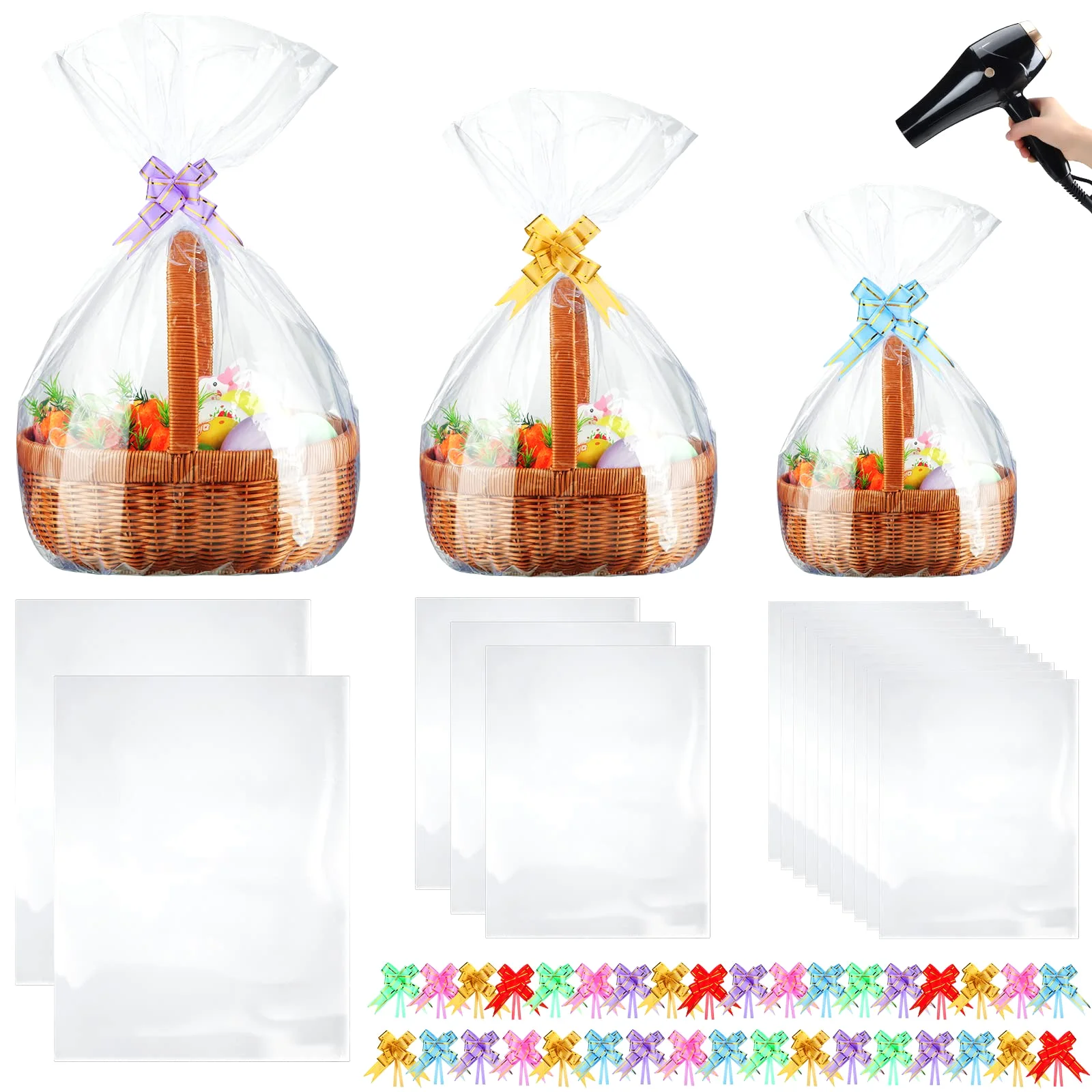
Gift baskets are a different problem from the table, because the basket is the product. CHENGU packs 95 shrink wrap bags for gift baskets at $13.99. That is about fifteen cents a bag, and it is the difference between a basket that looks like a gift and a basket that looks like a pile of stuff. What a basket needs: a base, a filler, a hero item, and a wrap. The base is the basket itself. The filler is the shredded paper or the tissue. The hero item is the thing the recipient will actually use. The wrap is the shrink bag that holds it all together and makes it presentable.
The trap is buying a hundred of something nobody takes home. A favor is only a favor if it leaves with the guest. A hundred keychains that sit in a bowl until 11 pm are not favors, they are inventory. Buy the thing that is useful enough to pocket, and buy it in the quantity that matches the guests who will actually take one. Shrink wrap bags are the exception, because they are useful whether the basket is a favor or a gift. Ninety-five bags at $13.99 covers a hundred guests with a few to spare, and the bags store flat. If the baskets are for a charity drive or a church group, the bags are the difference between a presentable basket and a cardboard box.
The honest advice: ask what the guest will do with it. If the answer is "put it on a shelf," buy something else. If the answer is "use it tonight," you have a favor.
Balloons and the last fifteen minutes
Balloons are the last thing up and the first thing down. CHENGU packs 50 racing flag latex balloons at $7.99. That is sixteen cents a balloon, and fifty is the right number for a hundred guests: one arch, or two clusters, or a ceiling. The fifteen minutes before people arrive are when balloons go up, and they are also when everything else goes wrong. The ice is melting, the first wave of food is going out, and someone is asking where the bottle opener is. Balloons are the one task that can be done in the last fifteen minutes and still look finished.
Under the CPSC rules, balloons are excluded from the small parts ban, but they still carry choking hazard warning labels. The risk is not the inflated balloon. It is the uninflated balloon and the burst pieces. A burst piece of latex is exactly the size and shape that a small child can choke on. If children under three will be in the room, keep uninflated balloons out of reach and pick up burst pieces promptly.
The racing flag pattern is a good choice for a party that has any kind of motion to it, because it reads as festive without being a specific holiday. Fifty balloons is enough to make a room feel dressed without looking like a carnival. The latex is the standard party grade, and it will last the evening if you do not overinflate. The last fifteen minutes are also when you check the small things: the bottle opener on the bar, the extra ice in the cooler, the stack of napkins that is lower than you thought. Balloons are the visible part. The invisible part is the walk around the room to check the bar, the ice, and the napkins.
Buy once, or buy for the evening
Some things you buy for the evening and let go. Some things you buy once and keep for the next ten years. The distinction is whether the thing has a life after the party. Buy for the evening and let go: plastic flutes, balloons, shrink wrap bags, chair sashes if you will never host a hundred again. These are priced to be disposable, and they are. The $43.99 pack of flutes is cheaper than the rental and the washing.
Buy once and keep: the napkin rings, the pour spout covers, the juice bottles, the shot board. These are small, they are made of metal or silicone or wood, and they live in a drawer until the next event. Ten matte gold napkin rings at $9.99 is a dollar a ring, and they will outlast the party by a decade.
The test is simple. If you can see yourself using it in a year, buy it and keep it. If you cannot, buy the disposable version and do not feel guilty. The guilt is the trap. Nobody needs a hundred chair sashes in their garage for the next five years. The middle ground is the thing that is cheap enough to keep and useful enough to reuse. The 36 pour spout covers at $31.99 is a dollar each, and they will be on your home bar for years. The 34 oz juice bottles in sixes at $32.99 is the same. These are not party supplies. They are bar equipment that happens to come in party sizes. The rule of thumb: if it costs less than a dollar per piece and it is made of metal, silicone, or wood, keep it. If it is made of paper or plastic and it has a party on it, let it go.
The packing list
Here is the list, in the order you will need it.
- Two days out: confirm the count, buy the non-perishables, wash the linens
- One day out: set the tables, arrange the chairs, blow up the balloons
- Morning of: chill the wine, make the ice, set up the bar station
- Two hours before: put out the first wave of food, light the candles
- At the start: pour the first round yourself, set the pace
- Two hours in: swap the food wave, refresh the ice, check the bar
| When | What | Notes |
|---|---|---|
| Two days out, morning | Confirm the count, buy non-perishables, wash linens | Do this before the stores get busy |
| Two days out, afternoon | Chill the wine, make the ice, set up the bar station | Ice needs a full day to freeze |
| Day before, morning | Set the tables, arrange the chairs, lay out the balloons and the pump | Inflate on the day: latex goes soft overnight |
| Day before, afternoon | Prep the food, chill the cold dishes | Label everything |
| Day of, two hours before | Final walk, light the candles, put out the first wave | Set a timer |
| Day of, two hours in | Swap the food wave, refresh the ice, check the bar | The second wave is the one that saves you |
The arithmetic, plainly. A hundred guests, four hours, standing. Two to three glasses per guest, so 200 to 300 glasses, which is two packs of 150 flutes. Two and a half to three drinks per guest, so 250 to 300 drinks, which is 17 to 25 bottles of wine, or 7 to 8 twelve-packs of beer, or 6 bottles of spirits, or a mix. Food in two or three waves, each smaller than the last, with a timer set when the first wave goes out.
The numbers are not magic. They come from the standard drink and the two hour food rule, plus one honest observation: people abandon glasses. Plan for the abandonment, pace the room, and swap the food on a timer. That is the whole guide.
Keep reading
- Buying for a room of thirty: the classroom and craft cupboard. The margin above thirty, the difference between a consumable and a tool, and what the labels on art materials are actually telling you.
- The multi-pack rule: which household things are worth buying by the dozen. Three questions decide it: does it get used up, does it get lost, does it store flat. Everything else should be bought one at a time.
- Or go back to CHENGU multi-packs and the fifty packs on the front page.